
Labor Law




In this section, we present detailed information about the origins of labor rights and employment conditions for PhD candidates. Which rights and conditions are applicable depends on the type of PhD contract and the employing institution. Below, you can find an overview of the labor rights as they apply to employed and non-employed PhD candidates.
Employed PhD candidates
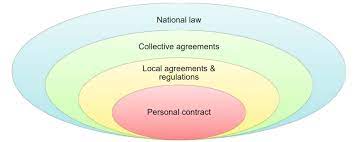
The building blocks of labor rights and employment conditions
Generally we can distinguish four levels from which labor rights and employment conditions originate: (1) National labor law, (2) Collective labor agreements (CLA’s), (3) Local agreements and regulations (e.g. PhD regulations), and (4) Personal contracts.
- National law. This applies to all employees in the Netherlands. Examples of relevant national laws include the Minimum Wage Act, the Working Hours Act, the Working conditions law, the Work and Care Act and the Civil Code.
- Collective labor agreements.This is an agreement the trade unions have made with the employer, and concerns all staff at a university, UMC, or research institute. This includes agreements on wages, working hours, bonuses, holidays and pensions. There are a variety of CLA’s under which PhD candidates might fall. The most common are the CLA Dutch Universities, the CLA UMC’s and the CLA research institutions..
- Local agreements and regulations. The main example of local regulations are the PhD regulations. This document addresses the general layout of the PhD trajectory, including the appointment of supervisors, the formalities of thesis submission and the course of events with regard to the (preparation of the) degree ceremony. Moreover, PhD regulations typically include provisions on conflict resolution and the termination of PhD trajectories.
Additionally, some provisions of the CLA are concretized on the local level. These regard practical matters and differ per institution. Examples include, commuting allowances, compensation for union membership, flexible holiday schemes etc. The right to be a promotor (ius promovendi) is also arranged locally. - Personal contract. This may contain agreements based on your personal situation. Examples are the general topic and structure of your PhD research, the formal appointment of your promotor and agreements on the ownership of the data you collect during your trajectory. This may also contain agreements related to the type of funding you receive for your trajectory. The Teaching and Supervision Plan (TSP) might also be integrated into the employment contract.
When it comes to general employment conditions the cla is the most comprehensive, whereas the PhD regulations contain the most PhD specific rules. When you do not fall under a CLA, generally you only have the minimum protection of national law. The CLA is more authoritative than your personal contract: what the CLA says always takes precedence over what your contract says.
Do you want to know more and work at a UMC? Contact Martine van der Linde for advice.

Martine van der Linde
Labour conditions - hospitals
Non-employed PhD candidate
Because of the status of not-employed PhD candidates, the labor rights and employment conditions associated with an employment contract (for example, through the CLA) do not apply to external and scholarship PhD candidates. In these cases, the conditions are established locally by the university and should be clearly stipulated in the agreement with the external or scholarship PhD candidate. For externally funded PhD candidates, the employment conditions applicable to their main employment apply.
PNN is aware of the structural inequalities that negatively affect non-employed PhD candidates and the shortcomings in terms of their affiliation with higher education institutions. In any case, as mentioned under ‘Start of the contract’ the agreement should clearly establish the services and facilities that the PhD candidate can have access to (e.g., supervision, training, funding, etc.) and under which conditions (e.g., in terms of fees or depending on the progress of the research project).
Furthermore, you should also be aware of the local agreements and regulations at your university. The most important local regulations for PhD candidates are the PhD regulations. This document addresses the general layout of the PhD trajectory, including the appointment of supervisors, the formalities of thesis submission and the course of events with regard to the (preparation of the) degree ceremony. Moreover, PhD regulations typically include provisions on conflict resolution and the termination of PhD trajectories. Another example that is arranged locally is the right to be a promotor (ius promovendi).
Social benefits
Because of their income level, scholarship PhD candidates may also be entitled to social benefits under Dutch regulations, for example, in terms of rent, healthcare, or child allowance. However, different rules apply with regard to eligibility for these benefits, so please contact the tax authorities for more information.
You can also find a list of frequently asked questions about labor rights for scholarship PhDs in the website of De AOb (labor union): https://www.aob.nl/en/lid-worden/veelgestelde-vragen-promovendi/

Are you currently experiencing issues during your PhD that you need help with?
Most institutions have a number of contact points for help. This compass is designed to help you find the right support.
In the drop-down menu you can select the institution that you are doing your PhD at. Then the roadmap will show you available contact points. In most cases it makes sense to start by considering contact points in your immediate work environment first and then progress to higher levels (like institutional or national).
At the bottom of the page you can find some examples of problems you can run into and a list of descriptions of each contact point.
Your first contact points
Colleagues: Sometimes it can already help to talk with your colleagues about the issue you are experiencing. This will help you judge the severity of it and can provide you with allies in taking further action.
Daily supervisor*: Naturally, your daily supervisor is the first contact point for all issues. They can help you determine the next steps. Of course, you may not feel comfortable discussing everything with your supervisor, or maybe your daily supervisor is involved in the issue. In these cases have a look at the other available contact points.
Promotor or Co-Supervisor*: Especially, in cases of issues with your daily supervisor, consider reaching out to your promotor or another member on the supervision team and ask for a one-on-one meeting. Maybe they can (temporarily) step-up and help you resolve the issue.If you have a conflict with your supervisor(s), you can also have a look at the PNN PhD supervisor conflict roadmap.
*Note that your annual review talk with your supervisory team is a good opportunity to address issues or suggestions for improvement.
National contact points
Labor unions: Organizations representing the interests of academic staff, offering support on employment-related matters, rights, and fair treatment.
NWO Scientific Integrity Desk: A specialized desk addressing scientific integrity concerns in projects related to or funded by the Dutch Research Council (NWO).
Netherlands Board of Research Integrity (LOWI): An independent body handling complaints related to scientific integrity, providing a platform for fair investigation. If you feel like the local scientific integrity committee at your institution did not handle a case correctly, the LOWI can be the next contact point.
Making a police report: In cases involving a criminal offense, please consider contacting local law enforcement to report incidents and seek assistance.