
The ideal university, at whose expense?
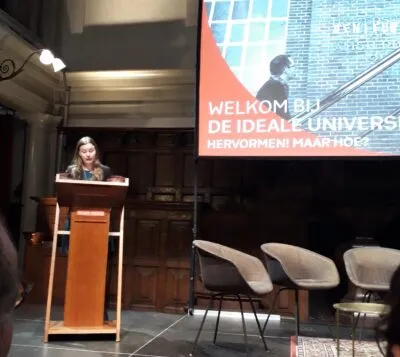
On Thursday, February 20, PNN chair Lucille Mattijssen participated in the panel discussion at the presentation of Floris Cohen's book "The Ideal University." Before the discussion, she was given the opportunity to briefly discuss how Floris Cohen designed the PhD system at The Ideal University. Her critical argument can be found below:
“Floris Cohen asked me to answer the following question: 'If you had to complete your own PhD according to my renovation proposal, would you be annoyed, would you be happier, or would you be somewhere in between?'”
The short answer to this question is: I would be absolutely mortified. Very, very mortified. And I have several reasons for that.
Let me start with the simplest, most practical reason: at the Ideal University, a PhD program would only take three years. I'm currently in my fourth year, so in practice, that would mean I'd no longer have a job. Even if my entire program had taken place at the Ideal University, I wouldn't necessarily have finished sooner: it's not that I would have more time for research at the ideal university than I do now, less in fact. That would be a problem for me, but probably for many PhD candidates as well. Because if the requirements for successfully completing a PhD program remain the same as they are now (and I'm assuming that's the case, since that's not addressed, apart from the time allocation), then three years is simply too short. Currently, the average PhD duration is about five years, so the four years most PhD candidates currently have is already a bit tight. Let alone what it would be like in three years. If the doctoral defense ceremony also has to take place within those three years, meaning that the dissertation must also be reviewed by a review committee and a replication agency within those three years, then in practice that leaves a maximum of two and a half years. That's simply not feasible.
But aside from these practical objections, I'd also be angry for a more fundamental reason. In the ideal university, the PhD program is "the completion of your studies at the highest level." PhD candidates are therefore accepted on a grant, and are therefore just students, just like at the bachelor's and master's level.
I strongly disagree with that.
Every PhD candidate will agree that the work performed during a PhD program is hardly comparable to pursuing a bachelor's or master's degree. While bachelor's and master's students primarily process and acquire knowledge, PhD candidates are responsible for the lion's share of research at Dutch universities—something Floris himself even states. Moreover, they contribute to education, including at the Ideal University. To put it in economic terms: they deliver output for the university. PhD candidates produce knowledge.
In the current system, this is, in most cases, rewarded with an employment contract that offers PhD candidates employment protection and a reasonable salary. The fact that the PhD candidate is indeed in training, and therefore less productive than a PhD-holding scientist, is already reflected in a lower salary. Removing employment protection while production is still being delivered is therefore unfair.
I personally consider obtaining a PhD, as the book also mentions, a specialized field. I don't quite understand why Floris believes that specialized training, for example, to become a doctor or lawyer, can take place within a professional setting, with a salary and employment protection, while specialized training to become a scientist results in student status. The fact that there are students at universities doesn't mean that you should reduce that specialized training to student status.
Floris, however, is not alone. In the Netherlands, and especially in the northern part of the country, many forces are active that strive to reduce PhD candidates to students. Professors and administrators are usually the ones advocating this, as they benefit from such measures. Even if the PhD bonus is abolished, as Floris proposes, the university will continue to profit from cheap labor, which conducts the lion's share of research.
These professors and administrators, however, fail to recognize that they are further degrading the most precarious group in academia—PhD candidates, even those with employee status. Worse still, they get away with this precisely because PhD candidates are driven and passionate about science, possessing that drive for knowledge that the book also refers to. This drive for knowledge makes these PhD candidates vulnerable to abuse, and they are shamelessly exploited. Moreover, PhD candidates have a strong dependency relationship with their supervisor, making it difficult for them to stand up for themselves: a dispute with your supervisor often means the end of your PhD program.
I find it extremely reprehensible that scientists, who themselves share that same drive for knowledge, abuse that same drive to exploit the most vulnerable group for their own gain. Even an Appeals Board will not be able to protect PhD candidates from this.
But besides the fact that PhD candidates are the victims of this scholarship system, I also think the Ideal University is ultimately shooting itself in the foot. Mr. Cohen already fears that the most talented of the youngest generation will turn their backs on the university. By worsening employment conditions for PhD candidates, and actually eliminating them entirely, there's a good chance that more and more talented people will turn their backs on academia. Because while a drive for knowledge may be valuable, it can't pay your rent (a mortgage isn't an option anyway; PhD candidates with scholarships can't get one). I know Mr. Cohen is proposing salary cuts to retain the intrinsically motivated, but intrinsic motivation doesn't equal talent. You're essentially left with only those who can afford to spend another three years in a precarious situation, for example, because they have parental support, and those who are truly willing to do anything to get a PhD, which by definition doesn't equate to having the most talent for a PhD.
At some point, less privileged talent will simply want to generate an income and reap the benefits of their accumulated human capital . The flexibilization of the labor market already leads to the postponement of many important life events for young people, such as buying a house and starting a family, let alone what happens when you add a precarious situation that isn't even a temporary employment contract. I think many talented individuals will take the risk and leave the Ideal University. To put this more personally: I would have left the Ideal University. And I'm currently working on an NWO research talent grant.
Ultimately, it all boils down to the core concept of appreciation: how much value is placed on the contribution PhD candidates make to the university? Apparently, there's little appreciation for PhD candidates within the Ideal University, because they are the only one of the six types of people who don't receive an employment contract. The Ideal University is therefore far from ideal for PhD candidates. And to be completely honest, hearing that some people think the work I and other PhD candidates do day in, day out isn't worthy of an employment contract, isn't real work, is simply painful.
And the best part is that Floris also expects PhD candidates, who aren't even worthy of an employment contract for the work they do, to further develop the Ideal University. Sorry, but we don't get paid for that.

More News
.jpg)